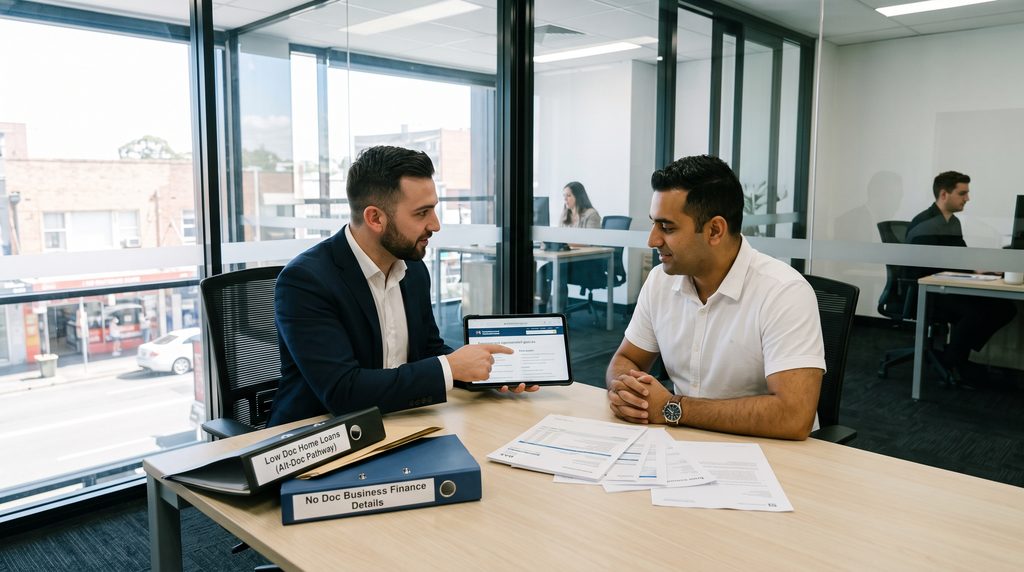

If you’re self-employed, run a small business, or work as a contractor in Bankstown or across Australia, traditional lending pathways can feel entirely out of reach. If you’ve ever sat down with a major bank and been asked for two years of company tax returns, complex P&L statements, and personal assessments that you simply don’t have ready, you’re not alone.
But a traditional tax file isn’t the only way to buy a home or invest in property. This is where Low Doc (Low Documentation) and No Doc (No Documentation) loans come into play.
Related — Outlook Finance Services
At Outlook Finance, we walk our local business owners through these specialized finance options every day. However, navigating this market in 2026 requires understanding the critical differences between No Doc and Low Doc loans, how the regulatory landscape has evolved, and exactly what you need to successfully qualify.
The Critical Difference: No Doc vs Low Doc
While “Low Doc” and “No Doc” are often used interchangeably in casual finance conversations, they represent entirely different pathways, especially in 2026.
+------------------+--------------------------------------+--------------------------------------+
| Feature          | Low Doc (Alt Doc)                    | No Doc (Commercial/Business Only)    |
+------------------+--------------------------------------+--------------------------------------+
| Purpose          | Home buying & Commercial Investment  | Commercial properties & Business     |
| Income Verified? | Yes (Using alternative documents)    | No (Assessed on asset & declaration) |
| ABN Required?    | Yes (Generally 12–24 months active)  | Yes (Registered for business use)    |
| Required Paper?  | BAS, Bank Statements, or Accountant  | Signing a "Declaration of Purpose"   |
| Normal deposit   | 20% or more (80% LVR or less)        | 30% to 50%                           |
+------------------+--------------------------------------+--------------------------------------+
What is a Low Doc Loan? (Alternative Documentation)
A Low Doc (also widely known as Alt Doc) loan is designed for borrowers who have a strong income but can’t produce traditional, up-to-date tax returns or payslips. Instead, you verify your earnings using alternative, everyday proofs of cash flow.
Low Doc loans can be used for standard residential home purchases, investment properties, and commercial properties alike. They still require income verification, but on your terms.
What is a No Doc Loan? (Strictly No Consumer Use)
A true No Doc loan requires no proof of income or personal financial capacity whatsoever.
The catch? No Doc loans for residential, consumer use do not exist in Australia. Under the National Consumer Credit Protection (NCCP) Act and the oversight of the Australian Securities and Investments Commission (ASIC), lenders are legally prohibited from providing consumer home loans without verify your capacity to repay.
However, No Doc commercial or business loans are still available. If you are buying a commercial site, warehouse, or seeking business funding through an active business entity, a lender may offer a No Doc loan . They evaluate the loan strictly based on the strength of the security (the property or asset) and a signed declaration stating that the funds are for non-consumer business purposes. Because there is no documentation, they carry higher risk, requiring much larger deposits (often 30% to 50% or more) and higher interest rates.
How to Qualify for a Low Doc (Alt Doc) Loan
Because major banks are highly conservative, qualifying for a Low Doc home loan involves compiling a strong, alternative financial file.
At Outlook Finance, we frequently packages and structures these applications to help clients meet the following standard criteria:
1. Active ABN & GST Registration
-
Lenders want to see that your self-employment or business is legitimate and stable (1.1.1). You’ll generally need an active ABN (Australian Business Number) for at least 12 to 24 months.
-
If your business turnover exceeds $75,000, you should also be registered for GST. Being GST-registered for the same period provides massive credibility.
2. At Least One Alternative Income Source
While you don’t need tax returns, you must show consistent cash flow. Most non-bank and specialist lenders will require at least one of these :
-
Business Activity Statements (BAS): Your last 6 to 12 months of ATO-lodged BAS, showing consistent operational turnover.
-
Business Bank Statements: 3 to 6 months of statements showing regular business deposits.
-
An Accountant’s Letter (Declaration): A signed, formal declaration from a qualified accountant confirming your estimated income and indicating your business has the capacity to cover the repayments. Be sure to confirm your accountant is legally registered by searching the Tax Practitioners Board (TPB) Public Register.
3. A Healthy Deposit (LVR constraints)
-
Because alternative documentation carries a higher risk, a 10% or 5% deposit will rarely be accepted for a Low Doc loan.
-
You will typically need a deposit of 20% or more (meaning a Loan-to-Value Ratio of 80% or less). A 20% deposit often helps you secure standard interest rates and bypass “Lender Protection Fees” or specialist risk premiums.
4. Strong Credit and Asset Profiles
-
Lenders assess your repayment history, credit file, and personal asset-and-liability position very closely. A clean credit record and evidence of “genuine savings” go a long way to getting your application approved.
The Outlook Finance Advantage
Trying to navigate the alternative lending landscape on your own can quickly result in frustrating, credit-damaging rejections. Not all banks offer these specialized products, and the ones that do maintain dramatically different and complex criteria.
At Outlook Finance in Bankstown, we do the heavy lifting for you. We are experts in self-employed and specialist lending, and have access to an extensive panel of non-bank and specialized commercial lenders.
-
We assess your exact cash flow to see which document pathway (BAS, bank statements, or accountant’s letter) paints your borrowing power in its truest, strongest light.
-
We can match you with the right non-bank lenders who look beyond a major bank’s “no”.
-
We can secure high-value property, development, and business loans up to $30 million.
Ready to put your business’s actual cash flow to work?
Talk to the self-employed lending specialists at Outlook Finance today to map out your pre-approval pathway.
📍 Visit Us: Level 2, 300 Chapel Rd, Bankstown NSW 2200
📞 Call Us: 1300 432 961
Outlook Finance | Australian Credit Licence 418711 | ABN 73 132 561 874
Disclaimer: The information provided in this article is general in nature and does not constitute personal financial, investment, or credit advice. Low Doc, No Doc, and specialized lending products can carry higher risk and differ significantly in terms. For specific advice tailored to your financial circumstances, please consult our specialists.
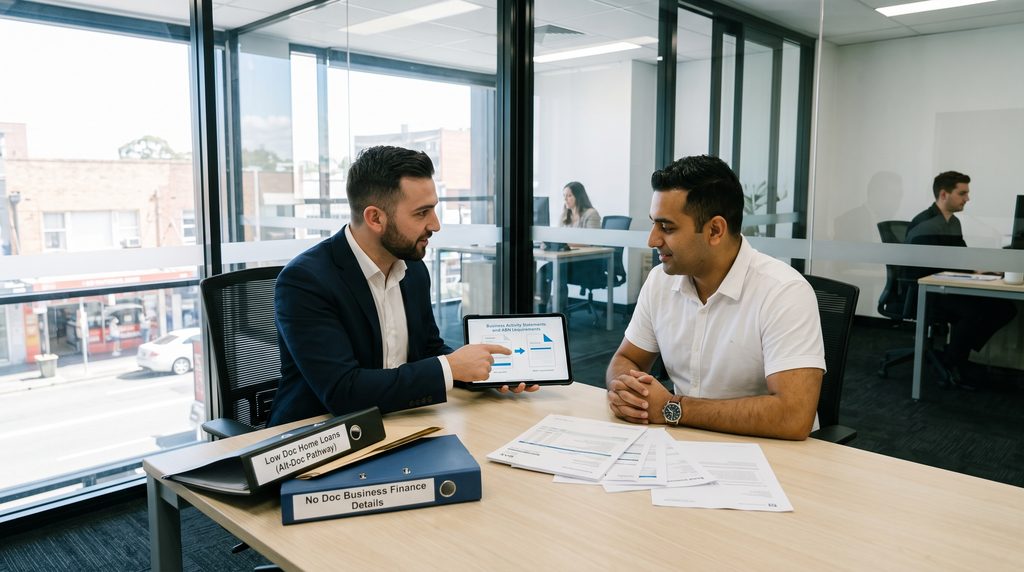
Key Takeaways
- No doc vs low doc loans provide alternative options for self-employed borrowers unable to provide traditional documentation.
- Low Doc loans require alternative income verification and can be used for home and commercial property purchases.
- No Doc loans do not require proof of income but are limited to commercial and business purposes only in Australia.
- Qualifying for a Low Doc loan involves active ABN registration, alternative income proof, healthy deposits, and good credit profiles.
- Outlook Finance helps navigate these lending options to secure loans up to $30 million for self-employed clients.
Outlook Finance | No Doc vs Low Doc Loans FAQ
Navigating alternative lending pathways can raise many questions for self-employed individuals and business owners in Bankstown and across Sydney. To help you understand these specialized finance options, we have compiled the answers to the most common questions about Low Doc and No Doc loans.
For additional resources on budgeting, saving, and managing various types of loans, you can visit the Australian Government’s Moneysmart website.
General Concept & Evolution FAQs
The main difference is the level of income verification required:
Low Doc (Low Documentation / Alt-Doc): You still prove your income, but you do it using alternative paperwork such as bank statements, BAS, or an accountant’s letter instead of tax returns .
No Doc (No Documentation): No proof of income, assets, or financial capacity is required. The loan is assessed strictly on the value of the security (the property) and the business’s purpose .
No. Under the National Consumer Credit Protection (NCCP) Act, lenders in Australia are legally prohibited from providing consumer/residential home loans without verifying the borrower’s capacity to repay the debt. “No Doc” home loans for consumer or owner-occupier use do not exist. If you want a residential home, you must go down the Low Doc (Alt-Doc) or traditional Full-Doc pathway
No Doc loans are available strictly for commercial, investment, or business purposes (1.1.8). If you are buying a commercial site, warehouse, or seeking business funding through an active business entity, a non-bank lender may offer a No Doc loan. They evaluate the loan based on the strength of the security (the property or asset) and a signed declaration stating that the funds are for non-consumer business purposes.
What do I need to qualify for a Low Doc (Alt-Doc) loan?
To qualify, lenders generally look for:
An Active ABN: Typically registered and active for at least 12 to 24 months.
GST Registration: Usually required if your business turnover exceeds $75,000.
One or More Alternative Income Verification Documents: Such as 6–12 months of BAS, 3–6 months of business bank statements, or a signed Accountant’s Letter.
A Healthy Deposit: Typically 20% or more (80% LVR or less).
Good Credit History: A clean credit file is highly beneficial.
An Accountant’s Letter (or Declaration) is a formal statement signed by a qualified accountant confirming your estimated income and indicating your business has the capacity to handle the proposed loan repayments. Before submitting this, you must ensure your accountant is legally registered by checking the Tax Practitioners Board (TPB) Public Register
.
Because No Doc loans carry much higher risk for the lender (as they do not verify your income), they require a much larger deposit to protect themselves. For a No Doc commercial loan, you should expect to provide a deposit of 30% to 50% or more (meaning a 50% to 70% LVR).
Are the interest rates higher for these types of loans?
Generally, yes. Since the lender is taking on more risk by not seeing traditional, up-to-date tax returns, both Low Doc and No Doc loans typically carry higher interest rates and fees than standard Full-Doc loans. Low Doc rates can still be highly competitive, whereas No Doc loans will usually carry a more significant risk premium.
The team at Outlook Finance is here to help you make sense of the alternative lending market and package your application for success.
Let’s chat today to discuss your pre-approval options. Reach out to our Bankstown office on 1300 432 961.
📍 Visit Us: Level 2, 300 Chapel Rd, Bankstown NSW 2200
Outlook Finance | Australian Credit Licence 418711 | ABN 73 132 561 874