

Why Sole Traders in Bankstown Need a Specialist Mortgage Broker
A mortgage broker for sole traders bankstown borrowers can rely on does one thing differently from a bank: it reads business income the way a lender’s credit team actually reads it, which is why so many locals search for a mortgage broker for sole traders bankstown.
The core problem is structural. A bank’s automated assessment wants a tidy, predictable salary. A sole trader’s income arrives in lumpy deposits, gets reduced by deductions, and often looks weaker on paper than the business actually is.
Related — Outlook Finance Services
The Gap Between Business Income and Bank Policy
Lenders do not assess a sole trader’s lifestyle. They assess serviceability: can this business reliably service a repayment at the assessment rate? That question gets answered with different evidence at different lenders. Some want two years of tax returns. Some accept one year of ABN plus recent business bank statements.
A specialist broker’s job is matching your evidence to the lender whose policy accepts it. That is the whole game, and it is why a generic comparison site will not help you here.
Ask any broker one question before you engage them: “Which lenders on your panel will accept one year of ABN with business bank statements?” If they cannot name specific policies off the top of their head, they do not work this niche often enough.
Self-Employed Home Loan Documents Lenders Actually Want
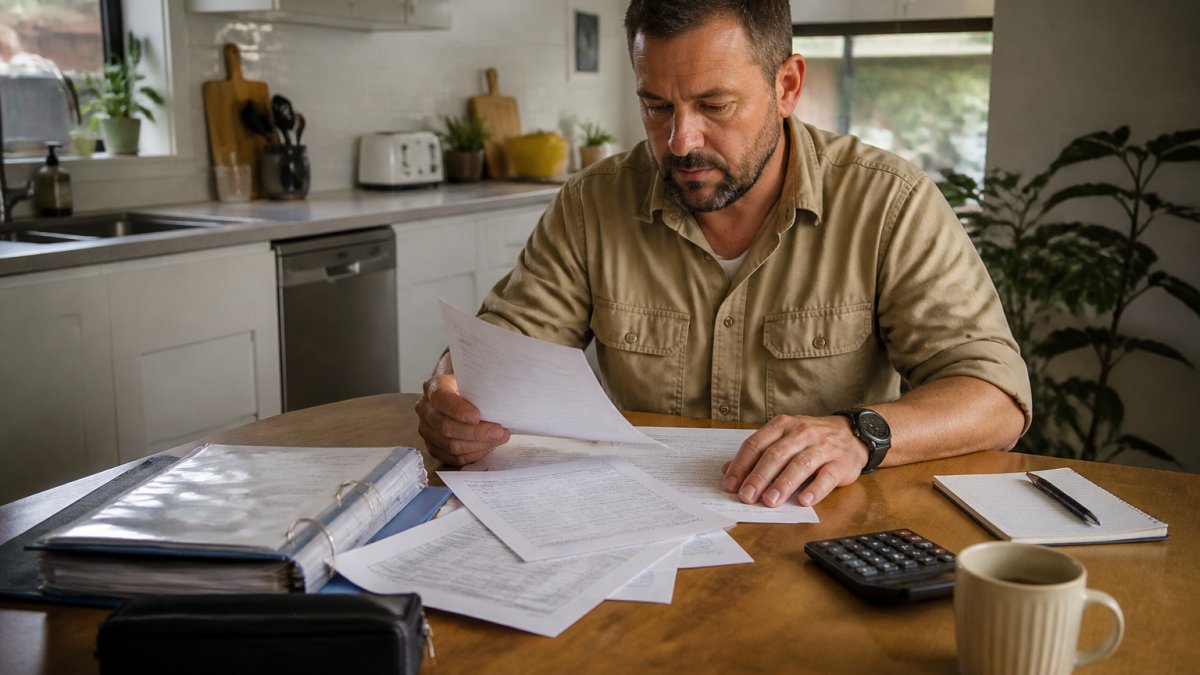
Self-employed home loan documents generally fall into four groups: identity, income, business verification, and deposit evidence. Lenders want to see that your declared income is real, repeatable and enough to cover repayments with a buffer.
A Practical Document Checklist for Sole Traders
Use this as a starting point. Which items apply depends on the lender and whether you are going full-doc or low-doc.
- Photo ID and proof of address
- ABN registration history (a summary from the Australian Business Register)
- Most recent one to two years of personal tax returns and notices of assessment
- Business tax returns, if lodged separately
- Profit and loss statements and balance sheets, prepared by your accountant
- Six to twelve months of business bank statements
- Six months of personal transaction account statements
- BAS lodgements, where available
- An accountant’s letter confirming income and business viability
- Evidence of deposit and genuine savings
- Existing loan statements and credit card limits
- Contracts or invoices showing current work in the pipeline
Missing paperwork is the most common reason a sole trader application stalls. Get the folder complete before you apply, not after a lender asks.
How Lenders Assess Income for Sole Traders
Lenders assess sole-trader income by starting with your declared net profit, adding back certain business deductions, then averaging results across one or two financial years. The add-backs matter enormously. Depreciation, one-off equipment purchases and some superannuation contributions can be added back, which lifts your assessable income above the tax return figure. But the order of operations and the lender’s specific policy on each item is where applications succeed or fail.
A Worked Example
Consider a sole trader with the following figures across two financial years:
| Item | Year 1 | Year 2 |
|---|---|---|
| Business income | $180,000 | $165,000 |
| Business expenses (including deductions) | $95,000 | $90,000 |
| Declared net profit | $85,000 | $75,000 |
| Depreciation add-back | $12,000 | $10,000 |
| One-off equipment add-back | $8,000 | $0 |
| Assessable income after add-backs | $105,000 | $85,000 |
A lender that averages the two years assesses income at $95,000. A lender that uses the lower year assesses $85,000. A lender with a more generous add-back policy on the equipment purchase might assess Year 1 at $113,000. Using identical paperwork, the borrowing capacity can shift by tens of thousands of dollars. That is why policy matching comes before rate negotiation.
The Mechanism Lenders Actually Apply
Most lenders follow a sequence: confirm the business is registered and trading, verify the declared income against tax returns and notices of assessment, apply their add-back schedule, then apply a serviceability buffer to the assessed income. The buffer is typically applied at an assessment rate above the actual product rate, which is why a modest declared profit can still service a loan if the add-backs are strong.
Two practical points:
- Averaging cuts both ways. If last year was strong and this year softer, some lenders average the two and some use the lower year. Policy choice changes your borrowing capacity.
- Business bank statement lenders look at deposits rather than net profit. That suits operators with cash flow that never fully appears in a tax return, but expect tighter loan-to-value limits and closer scrutiny of deposit consistency.
Ask a broker to show you the add-back schedule for two or three lenders on their panel before you apply. If they cannot explain how each lender treats depreciation and one-off expenses, they are not matching policy, they are guessing.
Low-Doc Home Loan Options for Self-Employed Borrowers
A low-doc home loan is a mortgage where the lender accepts alternative income evidence, such as an accountant’s declaration and business bank statements, instead of full tax returns.
The trade-offs are real and worth stating plainly. Low-doc typically comes with a lower maximum loan-to-value ratio, so you need a larger deposit.
Full-doc remains cheaper when you qualify for it. Our view: apply full-doc first, and treat low-doc as the fallback when your documents genuinely will not pass standard assessment.
Never inflate an accountant’s declaration or overstate business income to qualify for a low-doc loan. Lenders audit these, and a false declaration can void the loan and create legal exposure for you and your accountant.
Getting a Home Loan With One Year ABN
A home loan with one year ABN is possible, but the lender pool narrows sharply. Most major lenders want two years of business history.
What improves your chances with a short ABN history:
- A larger deposit, which reduces lender risk
- A clean credit file with no recent declines
- Strong business bank statements showing consistent deposits
- An accountant’s letter confirming the business is established and viable
- Evidence of prior industry experience, even before the ABN started
- A deposit that is genuinely saved rather than borrowed
If your ABN is under twelve months, expect to wait or expect to pay for the privilege. Anyone promising approval at prime rates with an eight-month ABN and a five per cent deposit is telling you what you want to hear.
Can You Get a Home Loan Without Tax Returns?
Yes. A home loan without tax returns is available through low-doc and asset-based lending, where the lender verifies income or equity differently. This is the pathway for business owners whose tax position is complex, whose returns are not yet lodged, or who need to release equity without handing over years of returns.
Expect these conditions:
| Requirement | Full-Doc | Low-Doc / No Tax Returns |
|---|---|---|
| Income evidence | Tax returns and notices of assessment | Accountant declaration and bank statements |
| Typical ABN history | Two years | From one year with select lenders |
| Maximum LVR | Generally higher | Generally lower |
| Rate positioning | Sharper | Higher |
| Paperwork volume | Heaviest | Lighter |
| Best for | Clean, stable declared income | Complex or recently lodged returns |
The honest caveat: no-tax-return lending costs more and borrows less. It solves a timing or documentation problem, not a budget problem.
Choosing a Mortgage Broker for Sole Traders in Bankstown
Choosing a mortgage broker for sole traders in Bankstown comes down to three checks: niche experience, lender panel breadth, and transparency about how they get paid. A broker who mainly writes PAYG loans will not know which credit policies accept an accountant’s letter. But the remuneration question deserves more than a passing mention, because it is where conflicts of interest hide.
How Broker Remuneration Actually Works
Most brokers are paid by the lender, not the borrower. That payment typically has two parts: an upfront commission based on the loan amount, and a trail commission paid over the life of the loan. Some brokers also charge the borrower a separate fee, which must be disclosed. The practical consequence is that a broker may earn more from a larger loan or from a particular lender’s commission structure. That does not make them dishonest, but it is a conflict you should understand and test.
Ask these questions before you proceed:
- How are you paid for this loan? Ask for the upfront and trail commission in writing, and whether any lender on their panel pays more than another.
- Do you charge me a fee? If so, what for, and is it payable if the loan does not proceed?
- How do you select lenders? Expect an answer about policy fit and document acceptance, not payout.
- What happens if I am declined? A specialist should have a second and third lender in mind, not a single application.
- Can I see your credit licence? Verify the broker’s Australian Credit Licence on the ASIC professional registers. Outlook Finance operates under ACL 418711.
Protections You Should Know About
Borrowers should understand their protections. The Moneysmart guide to home loans sets out how responsible lending works and what lenders must assess before approving credit. The Australian Securities and Investments Commission regulates credit licensees, so a licence check is a five-minute task worth doing. Best interests duty obligations also apply to brokers in many scenarios, which means they must act in your interest when providing credit assistance, ask them to explain what that means for your file.
A broker who shops your file to lenders with poor rates to chase a bigger commission is a real risk in this market. Ask directly how they select lenders, and expect an answer about policy fit, not payout. If the answer is vague, walk away.
The right broker for a sole trader is a policy matcher, not a rate chaser. Your approval usually hinges on which lender’s income assessment accepts your documents, and that decision comes before rate negotiation. Transparency about commission is the clearest signal of whether you are being matched or sold.
Conclusion
Sole traders in Western Sydney face a lending market built for payslips, and the paperwork gap is where most applications die.
Outlook Finance works with self-employed borrowers, contractors and tradies on exactly these scenarios. We specialise in self-employed home loans, offer low-doc options from one year of ABN, and can structure equity release up to 80% LVR without tax returns in suitable cases, with no payslips needed in many scenarios.
Frequently Asked Questions
Can a sole trader get a home loan in Australia?
Yes. Sole traders can get a home loan, but lenders assess income differently to PAYG employees. Most want to see your ABN, business bank statements, tax returns and notices of assessment, and they calculate borrowing capacity from your taxable income plus add-backs. Some lenders accept alternative income verification, such as business bank statements or an accountant’s declaration, which is where a low-doc home loan can help. A sole trader mortgage broker can match you to lenders whose policy fits your income pattern and documentation.
What documents do sole traders need to apply for a home loan?
Expect to provide photo ID, your ABN registration, business and personal bank statements (usually 6 to 12 months), the last two years of tax returns and notices of assessment, plus recent BAS statements if you are GST registered. Lenders may also ask for profit and loss statements, an accountant’s letter confirming income, and details of any existing debts. For a low-doc home loan, the list shrinks to ID, ABN, bank statements and a declaration of income, but the trade-off is a higher rate and stricter loan-to-value limits.
Can I get a home loan with one year of ABN history?
Some lenders accept a home loan with one year ABN, particularly where you have a strong deposit, clean bank statements and work in the same industry as before registering the business. Policy varies widely: many major lenders want two years of ABN history, while specialist and non-bank lenders are more flexible. A broker can identify which lenders on their panel accept one year and structure the application around your strongest evidence.
How long does a sole trader home loan application take?
A straightforward full-doc application with complete paperwork can move from pre-approval to formal approval in roughly two to four weeks, then settlement follows once contracts or valuations are done. Low-doc and one-year-ABN applications often take longer because lenders manually review bank statements and business income. Having your documents ready before you apply is the biggest time saver, and a broker can flag likely delays before they cost you a deadline.
Related Services
Book a free 15-minute discovery call with Atish Prasad — Outlook Finance. No obligation, just straight answers about your borrowing options.
📅 Book a Discovery CallOr call us on 1300 432 961 | WhatsApp 0481 712 907